MAD7 Gene Editing

A Class 2 Type V Cas12a nuclease, MAD7 is ideal for product development that relies on genome editing 

MAD7 provides freedom-to-operate

While CRISPR/Cas9 revolutionized how we study biology, its intellectual property situation has always been complex. Depending on how you are using it, you might have to pay licensing fees to three different organizations.

Fortunately, in 2017, the team at Inscripta, Inc. generously gifted the scientific community with broad access to MAD7, to expand the impact of CRISPR-type technology.

MAD7 is very similar to Cas9

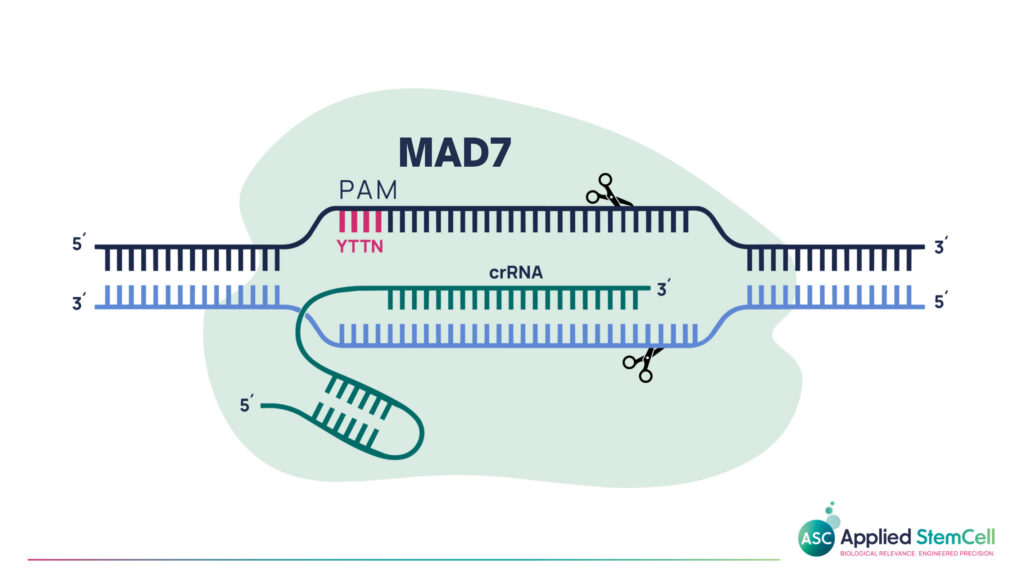
MAD7, or ErCas12a, is a Class 2 Type V Cas nuclease from Eubacterium rectale. Like Cas9, MAD7 is an RNA-guided nuclease. However, unlike Cas9, MAD7:

  • Uitilizes a single crRNA for target recognition without requiring a separate tracrRNA
  • Generates staggered double-strand breaks ~18 and 23 nucleotides 3′ of the PAM, as shown, producing 5′ overhags (“sticky ends”) rather than the predominantly blunt ends generated by Cas9
  • Recognizes a T-rich 5′-YTTN-3′ PAM (Y=C or T), expanding targetable sequences relative to the canonical 5′-NGG-3′ PAM recognized by SpCas9

We have years of success using MAD7 for gene editing in iPSC lines and HEK293 cells.
MAD7 applications

MAD7 can be used for many of the same applications as CRISPR/Cas9, including:

Cell line engineering

Product development

Interested in learning more about how we use MAD7?

Fill out the contact form below and a team member will be in touch within one business day.

References

  1. Rojek, J. , Basavaraju, Y. , Nallapareddy, S. , Baumgartner, R. , Schoffelen, S. & Pedersen, L. Mad7: an IP friendly CRISPR enzyme. Authorea. 2022. Available from: 10.22541/au.162863226.68733765/v1
  2. Price MA, Cruz R, Bryson J, Escalettes F, Rosser SJ. Expanding and understanding the CRISPR toolbox for Bacillus subtilis with MAD7 and dMAD7. Biotechnology and Bioengineering. 2020;117(6):1805-1816. doi:10.1002/bit.27312
  3. Mund M, Weber W, Degreif D, Schiklenk C. A MAD7‐based genome editing system for Escherichia coli. Microbial Biotechnology. 2023;16(5):1000-1010. doi:10.1111/1751-7915.14234