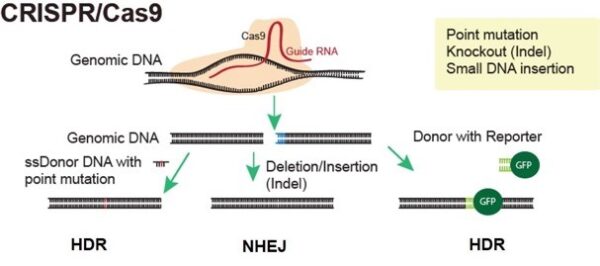
We design your custom CRISPR projects to work right the first time, with clear milestones, a defined scope, and a fast turnaround, keeping your project on schedule and on budget.
They need fast turnaround, clear milestones and cell lines they don’t have to redo. With our extensive experience in iPSCs and cell line engineering, combined with the 1,800+ unique cell line models engineered by our scientists, we’ve built our CRISPR services around:
*Timelines can vary depending on the edit type, cell type, and screening and clone validation requirements. Project-specific timelines are defined during the quoting stage.
Find out how our CRISPR services can enable your projects by submitting the form below. We will get back to you within one business day.
Editing services
Cell types we work with
What can it be used for
We assess your edit before work begins, so risks are identified and resolved early.
CRISPR editing and single-clone isolation.
Validated clones are expanded for delivery.
Edit confirmation by sequencing, clonality verification, mycoplasma testing, full characterization & off-target analysis. Project-specific assays available where applicable.
We deliver edited cell lines with QC reports and supporting documentation.
Your dedicated manager scopes project requirements with you, with our technical team on call if needed.
Your plan, your timelines, your milestones, all done in collaboration with our technical team. We handle the rest.
Send any materials you’re supplying, and we get to work.
As we work, we provide clear, transparent updates on your project's status, as agreed.
Delivered, according to predictable turnaround times (depending on project requirements).
"Working with Applied StemCell has been a great experience. They were responsive, flexible when challenges came up, and consistently delivered the gene-edited hiPSC lines we needed to support our Pharma projects."
Kitchener D. Wilson, CEO of Rosebud Biosciences[
“Here, we describe the characterization of two isogenic, gene-corrected lines, generated by Applied StemCell, Inc. (CA, USA) using a CRISPR/Cas9 approach (…). Two distinct gRNAs targeting the mutation site were selected based on prior in silico analysis, considering their distance from the target, predicted activity, and off-target profile (…). (…) Briefly, ribonucleoprotein (RNP) was complexed using purified SpCas9 protein and chemically synthesized RNA oligonucleotides (…).”
Generation of two isogenic control iPSC lines (LCSBi001-A-2 and LCSBi001-A-3) from a Parkinson’s disease patient line (LCSBi001-A) carrying the pathogenic VPS35 p.D620N mutation
“From the control iPSC line LUMC4iCTRL10 (now called: ISO-4.10), three CRB1KO and three CRB1KOCRB2+/− clones were generated using CRISPR-Cas9 technology (Applied StemCell). In short, guide RNAs were designed to target exon 2 of CRB1 and exon 3 of CRB2.”
Characterization and AAV-mediated CRB gene augmentation in human-derived CRB1KO and CRB1KOCRB2+/− retinal organoids
“Genome correction of the SPAST mutation in iPSCs was carried out by Applied StemCell. (…) Applied StemCell used the CRISPR/Cas9 system to correct the non-sense mutation in SPAST patients (…). (…) Genotype of iPSCs was confirmed by the Center of Human Genetics, Regensburg University (Prof. Ute Hehr).”
Store-operated calcium entry is reduced in spastin-linked hereditary spastic paraplegia
No more open-ended CRISPR engagements: share your project requirements and goals, and we return with scope, milestones and a project timeline. All customized to your needs.